Collars
 Leashes
 Charms
Minimalist Dog Accessories: How to Choose Less, but Better
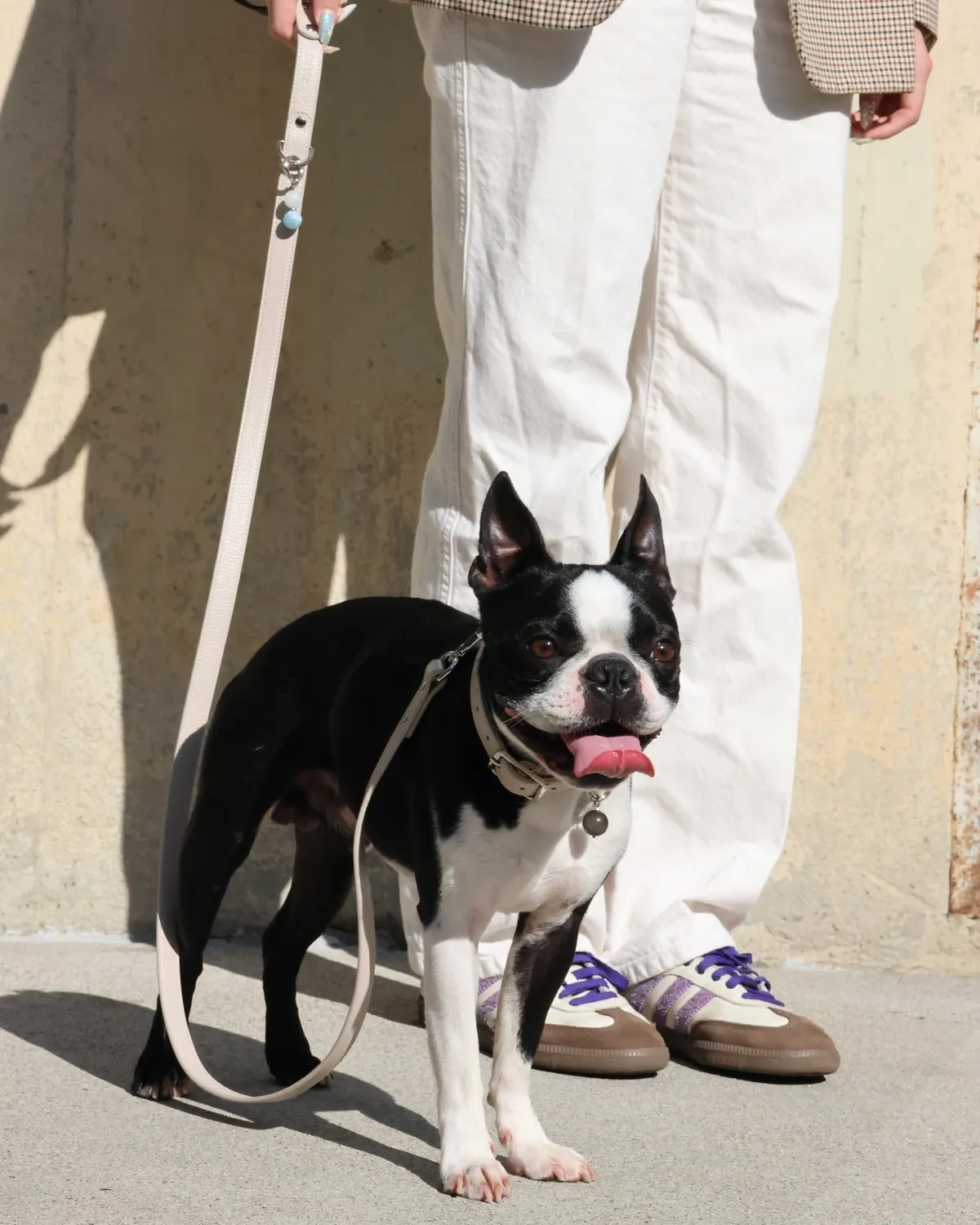
Minimalist dog accessories are the few pieces your dog wears every day, a collar, a leash and an ID tag, chosen for good material, a correct fit and a plain form with nothing added for show. Choosing them is less about buying a certain look than about leaving things out: fewer items, one honest material, quiet hardware, one small detail at most. The same thinking works for cats. Here is how to tell a well-made simple piece from one that is only plain.
What minimalist means for pet accessories
Minimalism in design is not a colour palette. It is a way of deciding what stays. The industrial designer Dieter Rams put it in three words, “Less, but better”, in the last of his ten principles for good design, where he argues that a product should concentrate on the essential and not be burdened with the rest.
Applied to a collar, that means every part has a job. The strap holds. The buckle closes. The ring carries a tag and a leash clip. Anything else has to earn its place, either because it helps or because it is the one detail that makes the piece yours. When you look at a collar and cannot say what a part is for, that part is decoration, and decoration is where most pet accessories go wrong.
Start with the short list
A dog needs very little to leave the house well dressed. Three things cover almost every day.
- A flat collar. The American Kennel Club describes flat-clip and buckle collars as the most widely available type and a convenient place to carry a name tag.
- A fixed-length leash. Standard flat leashes are usually four to six feet long, according to the AKC, and that range suits ordinary walks on pavement and in parks.
- Identification. American Humane advises that all dogs and cats wear a collar with an ID tag showing the owner’s name and phone numbers, with a registered microchip as a permanent backup.
That is the kit. A harness, a long training line or a coat can be useful for a particular dog, but they are additions for a reason, not part of the base. If you are starting from nothing, buy these three well and stop there for a while. You will learn what your dog really needs by walking, not by shopping.
Five things to look for
One honest material
A minimalist piece usually comes down to a single material used properly. Leather is the obvious choice for a collar because it needs no coating or print to look finished. Full-grain leather is the top layer of the hide with its natural surface left unaltered, so what you see is the material itself. Check the inside as well as the outside. A collar lined in the same leather feels the same against the coat as it looks from the front.
Hardware you barely notice
Good hardware is small, solid and quiet. Look for a metal buckle and ring in one finish, with no logo plate and no extra rings. Stainless steel suits the purpose because it stays the same colour after rain and washing. If the buckle is the first thing you see, it is too much.
A plain line and a quiet colour
Black, tan, taupe and other natural leather tones sit well against almost any coat, and they do not date. A collar in a quiet colour also lets the dog be the thing you look at. Width matters more than pattern: a narrow strap on a small dog or a cat, a wider one on a large dog, so the collar reads as one clean line around the neck.
Fit before looks
The simplest collar looks wrong if it hangs low or bites into the coat. Use the AKC’s two-finger test: if you cannot slide two fingers under the collar it is too tight, and if more than two fit it is too loose. Our guide on how to measure dog collar size walks through it step by step. Check the fit again every few weeks on a growing puppy.
One detail, not five
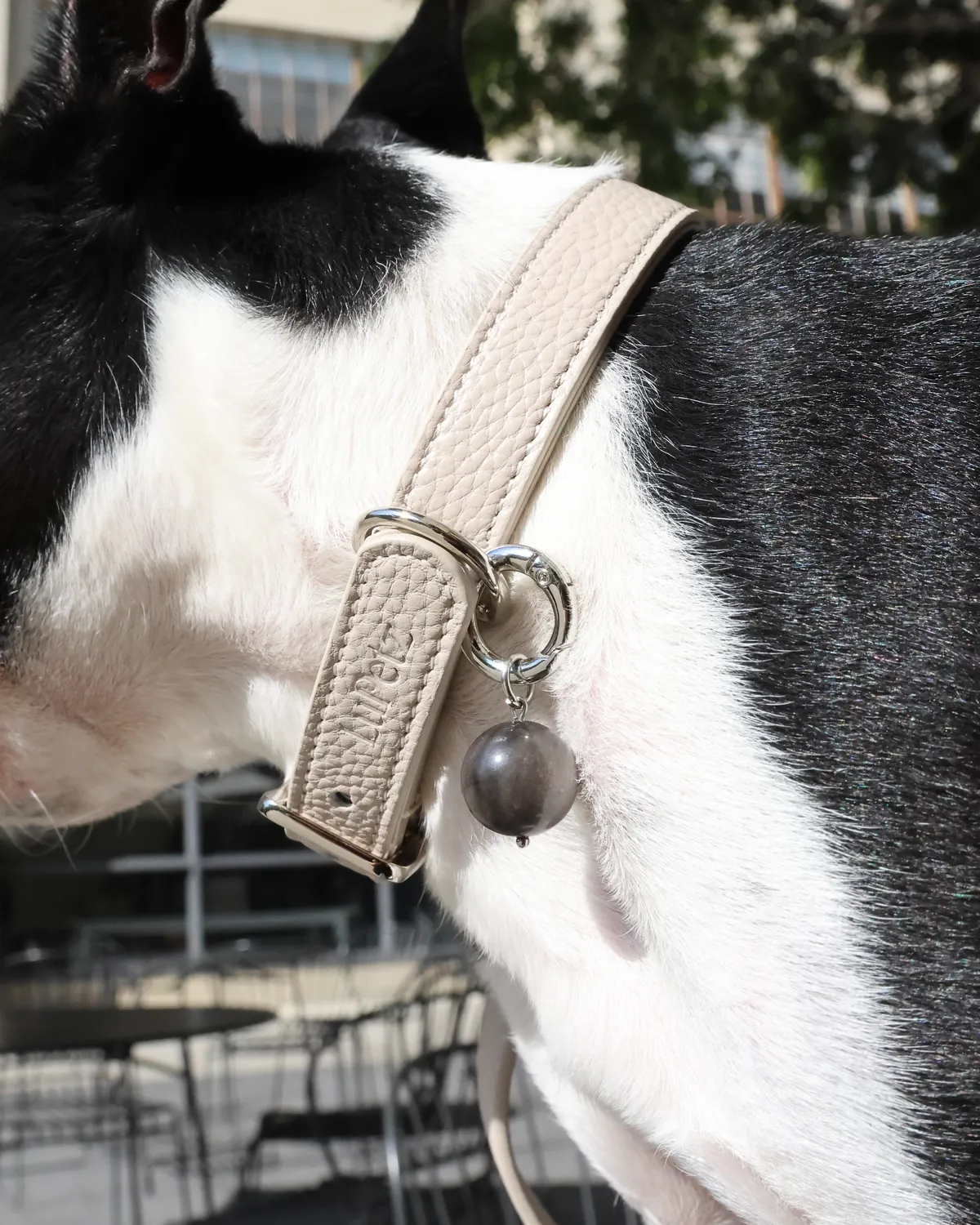
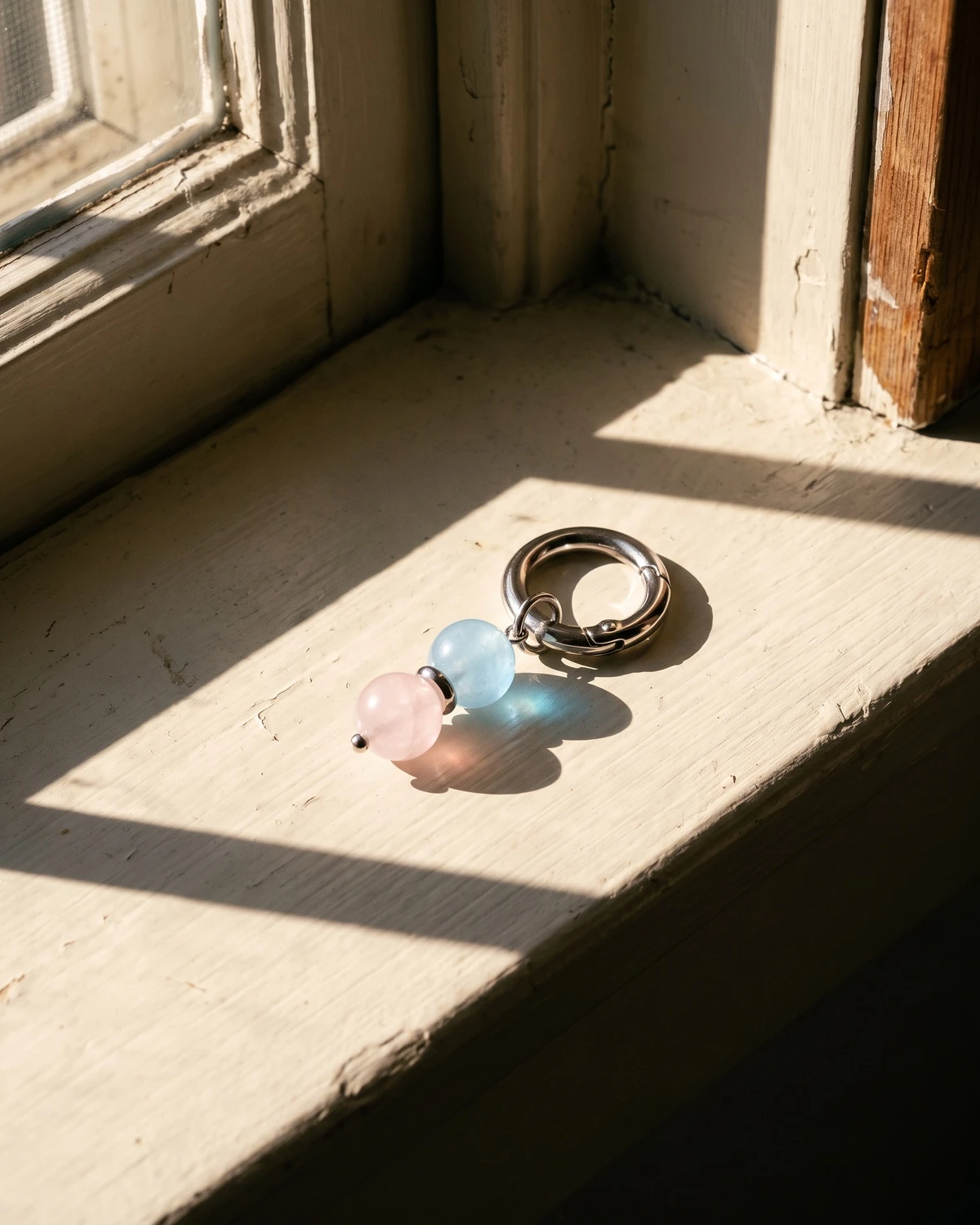
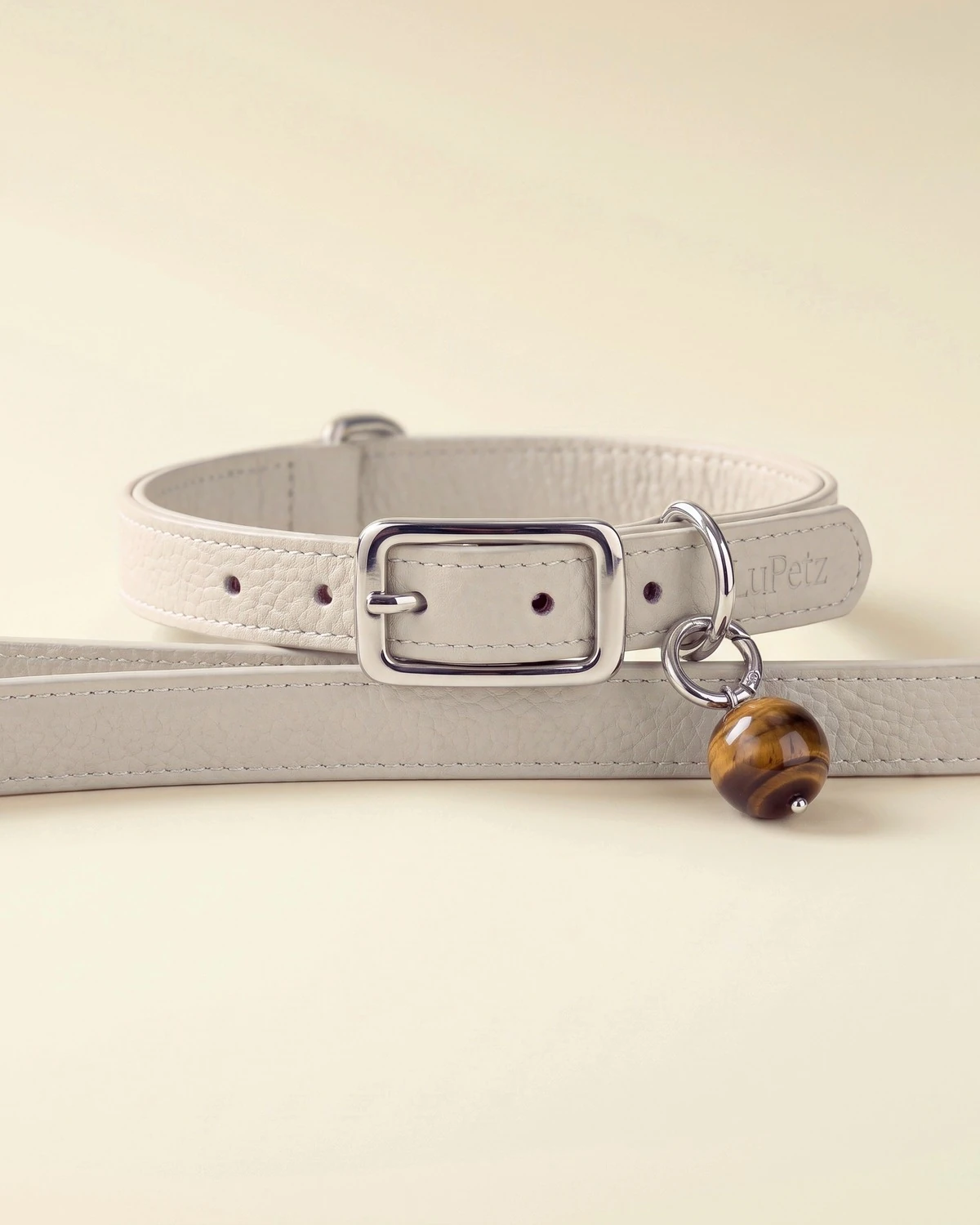
Minimal does not have to mean bare. One considered detail gives a plain piece its character, in the way a single ring does on a hand. On the LuKra leather collar that detail is a small natural stone charm. Each stone is natural, so its colour and pattern differ slightly from the next one. It is there because it is beautiful, like a piece of jewellery, and for no other reason.

What to leave out
Editing is most of the work. A few things are easy to skip.
- Studs, bows and dangling extras. The AKC notes that decorative additions can irritate the skin or snag during play, and advises choosing a safe collar before a stylish one.
- Loud prints and slogans. They are fun for a month. A plain strap still looks right in five years.
- Duplicates. One everyday collar that fits is better than four that almost do.
- Too many tags. One ID tag and whatever your city requires. Anything more is noise, in both senses.
A charm, if you add one, should be small and firmly attached. Charms and beads must not be chewed or swallowed, so take them off a dog who mouths at them, and keep an eye on any pet wearing an accessory for the first few days.
Collar and leash as one piece
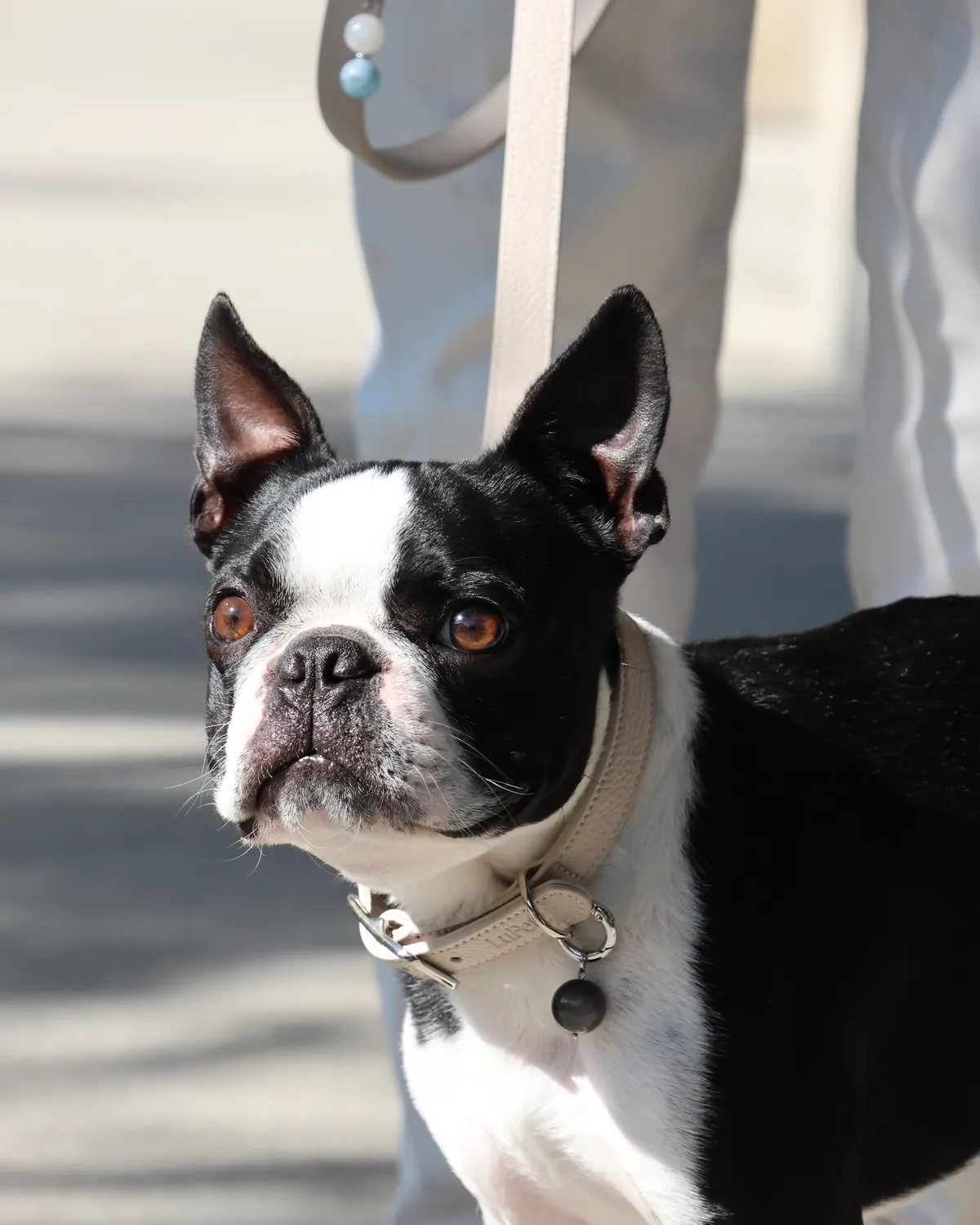
The quickest way to make a dog’s kit look considered is to match the collar and the leash: same leather, same colour, same hardware. The eye reads them as one object, and you stop thinking about what goes with what. The LuKra leather leash is made in the same Italian full-grain leather as the collar, 150 cm long, in black or taupe, with natural stone beads near the clip. US shipping is free when a collar and a leash are ordered together.
If you would rather begin with one piece, begin with the collar. It is the one your dog wears all day. You can see both colours in the collar collection.
Caring for a small kit
Owning less only works if what you own lasts. Leather asks for very little. Wipe it with a damp, soft cloth after a muddy walk and let it dry at room temperature. The AKC advises that leather should not be soaked, and that furniture or shoe leather cleaners should be avoided because their chemicals can be toxic to dogs. Our guide on how to clean a leather dog collar covers the full routine. A leather collar cared for this way softens with wear and keeps its shape.
Common questions
Are minimalist dog accessories only for small dogs?
No. The idea is the same at every size: one good material, a clean line, a correct fit. Only the width and the hardware change. A large dog needs a wider strap and a sturdier buckle, and both can still be plain.
Which colours count as minimalist?
Any colour that is quiet and close to the natural material. Black, taupe, tan and brown leather are the usual choices. A simple test is whether the collar still looks right next to every coat you own.
Do minimalist collars suit cats?
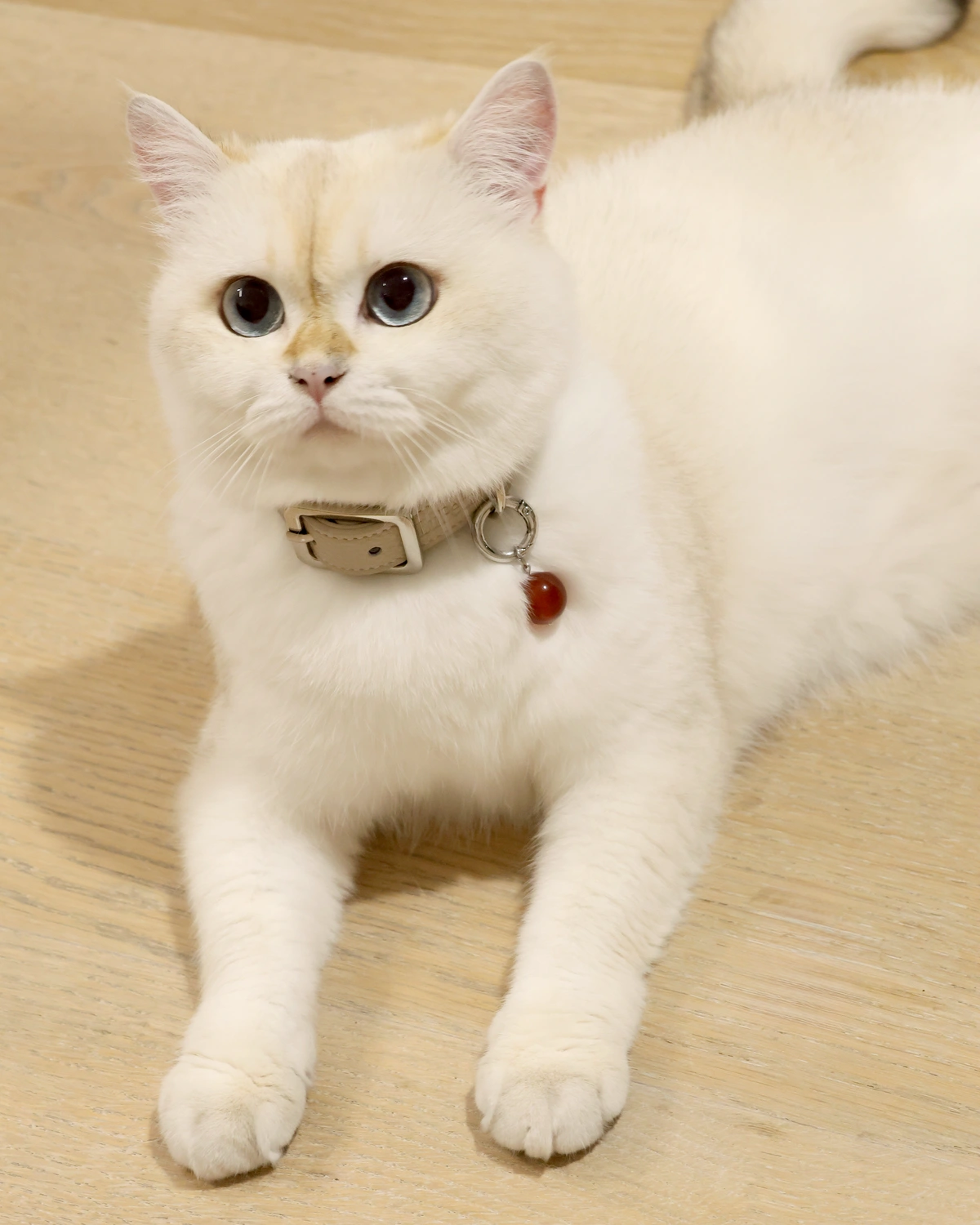
Yes, and a slim plain collar often suits a cat better than a busy one. The LuKra collar comes in three sizes and the smallest fits many cats. It is a buckle collar, so check the two-finger fit and supervise your cat while it wears it.
How many collars does a dog need?
One that fits and is worn every day is enough for most adult dogs. Puppies are the exception. The AKC points out that they grow quickly in their first year and may need several collars along the way.
Not sure which colour and stone suit your dog or cat? The LuPetz quiz takes about a minute and ends with a short list, which is how a minimalist likes it.