 Collars
 Leashes
 Charms
How Long Should a Dog Leash Be? A Practical Guide
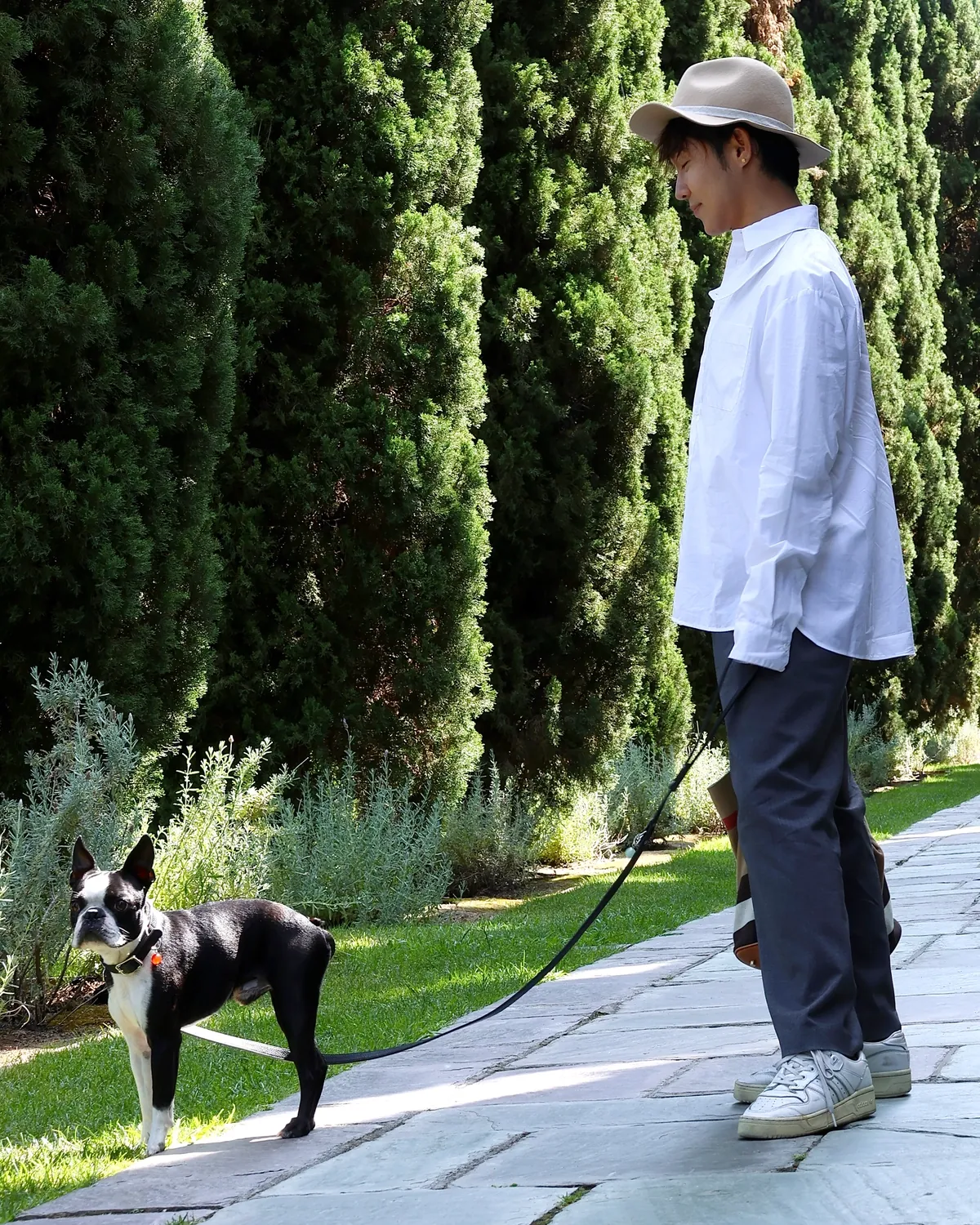
For everyday walks, a dog leash should be about four to six feet long. That range gives a dog enough slack to walk loosely at your side, and keeps it close enough to step out of the way of a bike, a stroller or another dog. Shorter leashes suit crowded streets; long lines suit open space and recall training. Below is how to choose, based on where you walk and how your dog walks.
The standard length: four to six feet
The American Kennel Club describes standard flat leashes as four to six feet long, and that is the length trainers usually suggest for teaching a dog to walk on a leash (AKC on choosing a dog leash). Whole Dog Journal gives the same range for everyday walking and loose-leash training: long enough to hang slack when your dog walks nicely, short enough to gather up without tangling (Whole Dog Journal on leash length).
Inside that range, a simple test helps. Clip the leash on, let your hand hang relaxed by your hip and let your dog stand beside you. The leash should drop in a soft curve below the clip. If it pulls straight, it is too short for that dog. If loops drag along the ground, it is longer than you need.
Match the length to where you walk
City streets and busy sidewalks
In town, keep to the shorter end, around four to five feet. Your dog stays on your side of the sidewalk, and you can bring it in close at a crossing without wrapping the leash around your hand. Many places also set a limit: in New York City parks, for example, dogs must be on a leash no longer than six feet outside off-leash areas and hours (NYC Parks rules for dogs). Check the rules where you live; six feet is a common ceiling.
Parks and quiet neighbourhoods
Here a full six feet gives your dog more room to sniff while staying under control. This is also where a dog that walks politely gets the most from a standard leash.
Trails, beaches and open fields
For open space, many owners add a long line. The AKC suggests long lines for recall practice, for letting a young dog explore and for uncrowded hikes; you feed the line out and gather it back in by hand (AKC). Whole Dog Journal mentions lines from 15 to 50 feet for recall work (Whole Dog Journal). A long line is a training tool, not a replacement for a daily leash.
Match the length to your dog
Size matters less than how your dog walks.
- Small dogs: length can stay standard, but weight matters. The AKC notes that a narrow, light leash is still strong enough for a small dog, and that a heavy one can feel awkward for a toy breed.
- Large or strong dogs: a wider, sturdier leash with a comfortable handle helps you hold on without strain, and the AKC points out it can prevent leash burn on your hands.
- Dogs still learning: stay with four to six feet. More length gives a puller more speed before you can react.
- Calm, experienced walkers: six feet lets them sniff and wander a little while the leash stays slack.
A word on retractable leashes
Retractable leashes can extend to around 30 feet. The AKC advises against them for dogs that are not yet leash trained, because the dog learns that pulling earns more room, and warns that grabbing the thin cord or tape can cause rope burn (AKC). The cord is also hard to see in the dark. For daily walks, a fixed leash of known length is simpler and more predictable for you and the people around you.
Where the LuKra leash fits
The LuKra leash is 150 cm, about 59 inches, or just under five feet. That puts it in the middle of the everyday range: long enough for a relaxed walk, short enough for a city crossing. It is cut from Italian full-grain leather, stitched by hand, with a stainless steel clip and a few natural stone beads by the clip as a quiet detail.
Leather has one practical advantage for a leash: it is comfortable to hold and easy to gather into loops when you shorten your grip. Care is simple. The AKC advises against soaking leather leashes; wipe off dirt with a soft, damp cloth and condition the leather from time to time (AKC). Our guide to cleaning leather covers the routine step by step.

A leash only works as well as the collar it clips to. Make sure the collar fits: you should be able to slide two fingers underneath it, no more (AKC on collar fit). Our dog collar size guide shows how to measure. Keep ID tags with current details on the collar for every walk, as the AVMA recommends (AVMA on walking your pet), and never let your dog chew the leash or its beads.
Common questions
Is a 4-foot or 6-foot leash better?
Four feet gives closer control on busy streets; six feet gives more freedom in quiet places. If you want one leash for everything, something around five feet is a sensible middle.
How long should a leash be for a puppy?
The same four to six feet works for most puppies. Choose a light leash, so the puppy is not dragging extra weight, and keep training sessions short.
Is a longer leash better for a dog that pulls?
Usually not. Extra length gives a pulling dog more momentum before the leash tightens. Stay within four to six feet while you work on loose-leash walking.
What length leash should I use for training recall?
Use a separate long line in an open, safe space. Keep your everyday leash for daily walks.
Choosing your leash
Start with where you walk most, then think about how your dog walks. For most dogs and most routes, a leash of about five feet covers it. If you want the leash to match the collar, see the leash collection and the LuKra collar in the same leather and colour. Order the two together and U.S. shipping is free.